Arcus pTokens Explained: Tokenized Leverage on Robinhood Chain
Table of Contents
A leveraged perp position is something you maintain: margin to watch, funding every hour, a liquidation price that follows you around.  Arcus's answer, launched on August 26, 2026, is the pToken: an ERC-20 on
  Robinhood Chain that wraps an Arcus perpetuals account running one fixed strategy. Buy pBTC3x and you hold a share of an account that keeps itself at 3x long BTC. There is no account of your own to open and no margin to post. You hold a token, and the token's value moves with the strategy, costs included.
This guide covers the live list, how NAV is built, what you pay, and the one piece of arithmetic every leveraged-token holder should run first.
What a pToken is
Arcus's launch post, pTokens: A New Primitive on Arcus, defines it plainly: "A pToken tokenizes an Arcus perpetuals account into an ERC-20 on Robinhood Chain, so that shares of that account can trade freely on spot venues." Your balance is a pro-rata share of everything that account holds, measured against total supply.
The first generation keeps the strategy narrow. Each pToken covers one market at one target leverage, both fixed when the vault is created. The account rebalances itself on a drift threshold rather than a daily clock: when exposure moves far enough off target, it trades back. In a volatile hour that can happen several times; on a quiet day, not at all. The post argues this keeps a falling position from compounding toward liquidation between scheduled rebalances.
For builders, the contract follows the ERC-4626 vault interface and specifically ERC-7540, the asynchronous vault standard, because minting and redeeming are not instant. That makes a pToken usable anywhere ERC-20s work: an AMM pair, a lending market's collateral list, a wallet.
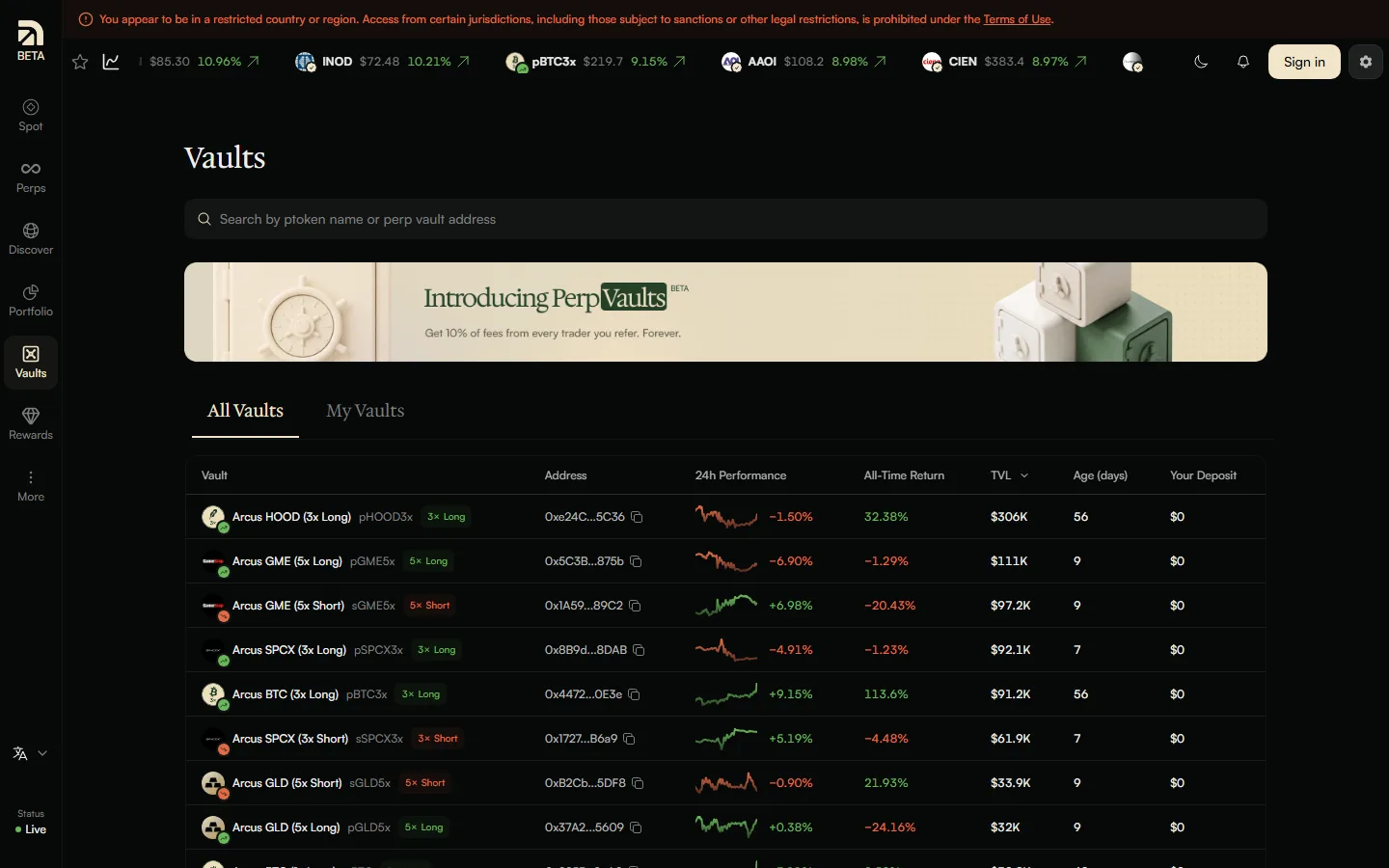
Arcus added a Vaults section to the web app on August 28 (frontend changelog). It lists each pToken with its NAV, a 24-hour sparkline, all-time return, TVL and deposit and withdraw buttons.
Two columns on that page are easy to misread. All-time return runs from the day each vault was created, so a vault launched in August and one launched in late September are not comparable side by side. And 24h performance on a 5x vault is a five-times-levered day, which means a quiet day for GME can still show a large swing on pGME5x. The Age column is your guide to how much history a number rests on: at the capture, the GME, GLD and SPCX vaults were 7 to 9 days old. The My Vaults tab shows only the vaults your connected wallet holds.
The live pToken list
The naming is consistent: p for long, s for short, then the market, then the leverage. Data below is from GET https://api.vaults.arcus.xyz/v1/vaults, pulled 2026-10-02 at about 04:34 UTC.
| pToken | Strategy | Deposit fee | TVL | Created |
|---|---|---|---|---|
| pHOOD3x | 3x long HOOD | 0.25% | $306.1K | Aug 7 |
| pGME5x | 5x long GME | 0% | $111.1K | Sep 22 |
| sGME5x | 5x short GME | 0% | $97.2K | Sep 22 |
| sHOOD3x | 3x short HOOD | 0% | $95.3K | Sep 4 |
| pSPCX3x | 3x long SPCX | 0% | $92.1K | Sep 24 |
| pBTC3x | 3x long BTC | 0.25% | $91.2K | Aug 7 |
| sSPCX3x | 3x short SPCX | 0% | $61.9K | Sep 24 |
| sGLD5x | 5x short GLD | 0% | $33.9K | Sep 22 |
| pGLD5x | 5x long GLD | 0% | $32.0K | Sep 22 |
| pBTC | 1x long BTC | 0.25% | $30.8K | Aug 20 |
| sBTC3x | 3x short BTC | 0.25% | $26.8K | Aug 20 |
| sBTC | 1x short BTC | 0.25% | $15.7K | Aug 20 |
Those twelve add up to about $994K. The API also returns two test vaults (pTEST and pTESTR) and two small SPCX vaults named "5x" that are configured at 3x leverage and hold under $1,100 between them; I left those out. No vault takes a profit share (profitShareBps is 0 across the board). DefiLlama tracks the same pool as "Arcus pTokens" at roughly $0.99M.
For scale: Arcus says the whole exchange holds "$25M+" to "$28M+" in total value locked (its two October 1 posts give different figures). pTokens are a small corner of it, and the thinnest vaults hold a few tens of thousands of dollars.
How NAV works
NAV is what one pToken is worth: the account's positions plus any cash, divided by every token in issue. Arcus is clear that "NAV is not the price of the underlying market. It is what holding the position actually earns and costs." Three things move it. The market comes first: over short horizons a 3x long gains or loses roughly three times the underlying's move. Funding comes next. The account pays or collects hourly perp funding, and it flows straight into NAV, so when longs are paying, a 3x long BTC vault pays three times what a 1x position would. Last, every rebalancing trade pays fees and slippage, and those come out of NAV too.
New tokens are minted at an oracle-signed NAV, never at a stale number. Arcus describes the flow in five steps:
Request
A mint request is submitted and the USDG behind it is escrowed.
Accept
The vault manager accepts the request and deposits the USDG into the perps account.
Process
The exchange processes the deposit; large deposits fill in parts so the account stays fully invested.
Sign NAV
An off-chain NAV oracle signs the value at the exact moment of processing.
Mint
The contract verifies the signature and mints pTokens at that signed NAV.
Redemptions run the same path in reverse. That is the primary market. Arcus calls the secondary market "the route in and out" for holders: buying and selling the token on Arcus or on a  Uniswap pool, which Arcus says is "open to everyone from day one."
On the secondary market, what you pay is the market price, not NAV. Arcus warns the two "may diverge for two reasons: liquidity can be thin, and supply does not expand the moment demand does." Its advice is short: "Check both numbers before you trade. The distance between them is information." Buying above NAV means paying a premium the arbitrage may later close.
What you pay
| Cost | Who charges it | Size |
|---|---|---|
| Deposit fee (primary mint) | The vault | 0.25% on pBTC, pBTC3x, pHOOD3x, sBTC, sBTC3x; 0% on the rest |
| Profit share | The vault | 0% on every vault |
| Funding | Paid inside NAV | Hourly, scales with leverage |
| Rebalancing fees and slippage | Paid inside NAV | Depends on volatility and book depth |
| Pool spread and price impact | The secondary market | Depends on pool liquidity |
Funding rates on Arcus are covered in the fees guide, and current rates are on the funding rates tool.
Volatility decay: the arithmetic to run first
A leveraged token resets its exposure as prices move. After a rise it holds more exposure; after a fall it holds less. That is what keeps it at 3x, and it is also why a 3x token does not return three times the underlying over longer periods.
Take the simplest case: the underlying rises 10% one day and falls back to its starting price the next (a 9.09% drop). Assume the vault rebalances once at each day's end, and ignore funding and fees.
| Start | After day 1 (+10%) | After day 2 (−9.09%) | Net | |
|---|---|---|---|---|
| Underlying | $100.00 | $110.00 | $100.00 | 0% |
| 1x long | $100.00 | $110.00 | $100.00 | 0% |
| 3x long | $100.00 | $130.00 | $94.55 | −5.45% |
| 3x short | $100.00 | $70.00 | $89.09 | −10.91% |
The underlying went nowhere. The 3x long lost about 5.5% and the 3x short lost about 11%. Repeat that chop for a few weeks and the losses compound; a 5x token decays faster still. pTokens rebalance on thresholds rather than at a daily close, so real results follow the actual price path, but the direction of the effect is the same. Leveraged tokens reward trends and punish range-bound markets.
Stock pTokens and the off-hours regime
Other risks worth naming
Each vault has a manager address that accepts mints and redemptions, and an off-chain oracle signs the NAV. The audits Arcus lists (Trail of Bits and OpenZeppelin) cover its rootchain contracts. I found no published audit of the pToken contracts themselves, which is worth weighing before you park real money in one.
Exits are the other thing to plan for. Primary redemptions are asynchronous and large ones fill in parts, so in a fast market the secondary pool may be your only quick way out, at whatever price it offers. Several vaults hold well under $100K, and a big sell order into a small pool moves the price against you.
Finally, threshold rebalancing lowers liquidation risk. A sharp one-way move in the wrong direction still costs you three or five times the underlying's loss.
Trade Arcus for 5% less
Join with code ARCUSGUIDE and Arcus takes 5% off your trading fees, automatically. It costs nothing, and the code attaches at signup, so add it on day one.
Get 5% Off Arcus FeesListed on CoinGecko and DexScreener, but not "the Arcus token"
Search "Arcus token price" and pTokens are often what you find.  CoinGecko lists five of them: PBTC, PBTC3X, SBTC, SBTC3X and PHOOD3X (ids such as
 arcus-btc-3x-long and arcus-hood-3x-long).  DexScreener shows their Uniswap pools on Robinhood Chain, including pGME5x and pSPCX3x.
These are official Arcus vault tokens. They are not a governance token, they give no claim on Arcus's revenue, and they say nothing about a future airdrop. Arcus's Help Center states that Arcus "does not currently have a token." The ARCUS ticker on CoinGecko belongs to Arcus Network, an unrelated AI-payments project, and several fake "Arcus" tokens trade on Robinhood Chain itself. If you are verifying a pToken, match the contract address against the Vaults page in the app; for example, pHOOD3x is 0xe24cabdf76dd1c2576049167eb1755c84b985c36. More on the token question in Arcus points, token and airdrop, and on fakes in Arcus scams and fake sites.
pTokens are not an HLP-style liquidity vault
On  Hyperliquid, "vault" usually means HLP, a pooled vault that makes markets, takes over liquidations and shares the result with depositors (HyperliquidGuide's HLP explainer covers it in depth). Arcus works differently. Its Help Center says order book liquidity comes "from anchor market makers quoting directly on the matching engine, not retail liquidity providers (LPs) in vaults."
| Arcus pToken | HLP-style LP vault | |
|---|---|---|
| What the money does | Holds one directional leveraged position | Makes markets across many books |
| Your return comes from | The market's move, minus funding and costs | Spread capture, liquidations, trading PnL |
| Exposure | Long or short one asset, 1x to 5x | Roughly market-neutral, with tail risk |
| Exit | Sell the ERC-20, or redeem asynchronously | Vault withdrawal rules |
If you want yield from providing liquidity, pTokens are the wrong tool. If you want leveraged exposure without running a perps account, that is the job they do.
How to get pTokens
You need USDG on Robinhood Chain and access from an eligible region; Arcus restricts the US, Canada, the UK and sanctioned regions. From there, open Arcus, go to Vaults, pick a token and deposit, or buy it on the secondary market. How to deposit on Arcus covers funding, and what is Arcus covers the wider product. If you would rather run the position yourself, how to trade on Arcus explains the perps side, which needs an invite code or waitlist slot.
Get leveraged exposure without a margin account
Join Arcus with code ARCUSGUIDE and Arcus applies its 5% referral discount on trading fees whenever you trade perps yourself.
Open Arcus with ARCUSGUIDEArcusGuide earns a share of the trading fees paid by accounts that join with code ARCUSGUIDE. Leveraged tokens can lose value quickly and are not suitable for everyone. Nothing here is financial advice.
Frequently Asked Questions
A pToken is an ERC-20 token on Robinhood Chain that represents a pro-rata share of an Arcus perpetuals account running one strategy, such as a 3x long position in BTC. The account rebalances itself to keep the target leverage, and the token's value (NAV) absorbs funding and rebalancing costs.
No. pTokens such as PBTC, PBTC3X and PHOOD3X are official Arcus vault tokens that give leveraged exposure to one market. They are not a governance token. Arcus says it does not currently have a token, and the ARCUS ticker on CoinGecko belongs to an unrelated project called Arcus Network.
Per the Arcus vaults API on 2026-10-02, pBTC, pBTC3x, sBTC, sBTC3x and pHOOD3x charge a 0.25 percent deposit fee and the newer vaults charge none. No vault takes a profit share. Funding, trading fees and slippage from rebalancing are paid inside the vault and show up in NAV.
Because the vault rebalances to its target leverage as prices move. After a rise it holds more exposure and after a fall it holds less, so a market that goes up and then back down leaves a 3x token below where it started. This is called volatility decay, and it grows with leverage and with choppy markets.
No. HLP-style vaults pool deposits to make markets and share the trading results. Arcus pTokens hold a directional leveraged position in one market. Arcus's Help Center says its order book liquidity comes from anchor market makers, not retail liquidity provider vaults.
Independent resource: ArcusGuide is an independent, third-party resource operated by Concept211. It is not affiliated with, produced by, reviewed by or endorsed by Arcus Labs Ltd, Arcus Labs Inc., Pocket Protector Labs Inc., dYdX Trading Inc. (dYdX Labs), the dYdX Foundation, Robinhood or any of their affiliates. "Arcus" and related names and marks belong to their respective owners and are used here only to identify the platform this site documents. Read the full disclaimer.
Availability: Arcus perpetual contracts and derivatives trading features are not available to persons in the United States, Canada, the United Kingdom or other restricted or sanctioned jurisdictions, and Arcus restricts spot trading there too. This site is not intended for persons in those jurisdictions. Do not use a VPN or any other tool to get around a regional restriction; Arcus prohibits it.
Not advice: Nothing on this site is legal, tax, financial or investment advice. Descriptions of regulatory status, tax treatment and market availability are general information that varies by jurisdiction and changes over time. Confirm anything that matters to you with a qualified professional and against primary sources. Trading perpetual futures with leverage carries a substantial risk of loss, and past performance does not indicate future results.
Disclosure: this site contains referral links. Joining Arcus with code ARCUSGUIDE takes 5% off your trading fees and earns us a share of the fees Arcus already charges, at no extra cost to you.
Trade Arcus for 5% less
Join with code ARCUSGUIDE and Arcus takes 5% off your trading fees, automatically. It costs nothing, and the code attaches at signup, so add it on day one.
Get 5% Off Arcus Fees