Trading Stocks 24/7 on Arcus: Stock Tokens, Equity Perps and Off-Hours Pricing (2026)
Table of Contents
- Two instruments, two clocks
- Stock Tokens: what you own
- Which names trade on weekends
- What it costs at 3 a.m.
- Settled, unsettled and the wrapped-token fallback
- Equity, index and commodity perps
- The off-hours regime, rule by rule
- Weekend gap risk: a worked example
- Dividends and corporate actions: the docs and the Help Center disagree
- Points boosts for off-hours and RWA trading
- Who can trade this
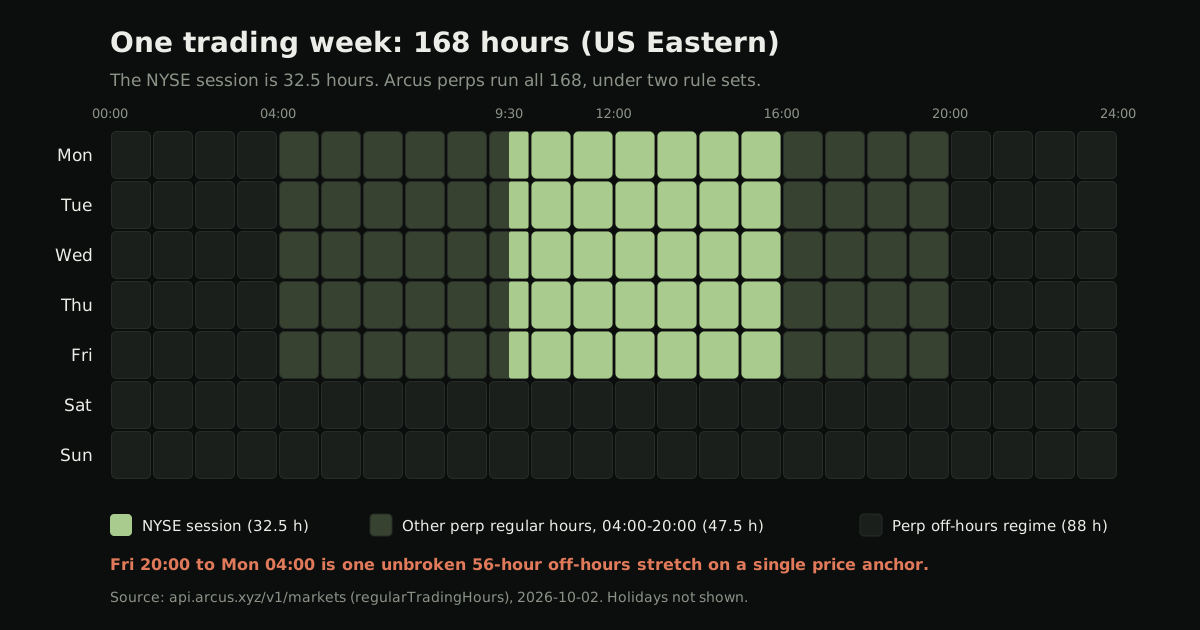
The US stock market is open for 32.5 of the 168 hours in a week. That number comes from Arcus's own blog, and the other 135.5 hours are its whole pitch.  Arcus gives you two ways to hold stock exposure in those hours: Stock Tokens, which you own outright and trade spot with no Arcus fee, and equity perps, which are leveraged contracts that never close. Both trade at 3 a.m. on a Sunday. They handle that hour in very different ways, and the difference decides what a weekend can cost you.
Two instruments, two clocks
Most of the confusion about "24/7 stocks" comes from treating the two products as one. They share a ticker and a chart. Nearly everything else differs.
| Stock Tokens (spot) | Equity, index and commodity perps | |
|---|---|---|
| What you hold | A token in your own wallet | A leveraged position against USDG margin |
| Issuer / counterparty |  Bitstamp issues the tokens; makers quote via RFQ Bitstamp issues the tokens; makers quote via RFQ | Other traders on a central limit order book |
| Hours | 24/7 for the most liquid names, 24/5 for others | 168 hours a week, two rule sets |
| Leverage | None | Up to 50x (SPY only); most single stocks 10x |
| Arcus fee | 0% | 0.0225% taker, 0% maker at the base beta tier |
| Off-hours cost | Wider spread in the quote | Higher initial margin, bands, fixed funding |
| Liquidation | Not possible | Possible |
| Access | Eligible regions, no waitlist | Invite code or waitlist slot |
Fees are from the live GET https://api.arcus.xyz/v1/feetiers endpoint (2026-10-02); the full schedule is in Arcus fees explained. The rest of this guide takes each product in turn, then puts them side by side for a weekend.
Stock Tokens: what you own
A Stock Token is a tokenized claim on a US stock or ETF, held in your wallet on  Robinhood Chain. Per the Stock Tokens page of Arcus's docs, the tokens are minted by Bitstamp Global Ltd. (BVI), and Arcus is the venue, not the issuer. The token gives you "a contractual right to redeem with the issuer for the cash market value of the linked security," not a share certificate.
In practice that means you get the price exposure and give up the paperwork rights. Voting is not passed through. Dividends never land as cash: their value is reinvested into the backing, and an on-chain oracle update nudges your displayed balance up instead. Splits work the same way. The tokens are self-custodied, so Arcus cannot move them, with two narrow exceptions: transfers to sanctioned addresses are blocked, and a fresh purchase may be locked for the roughly 5 to 15 minute settlement window (Help Center).
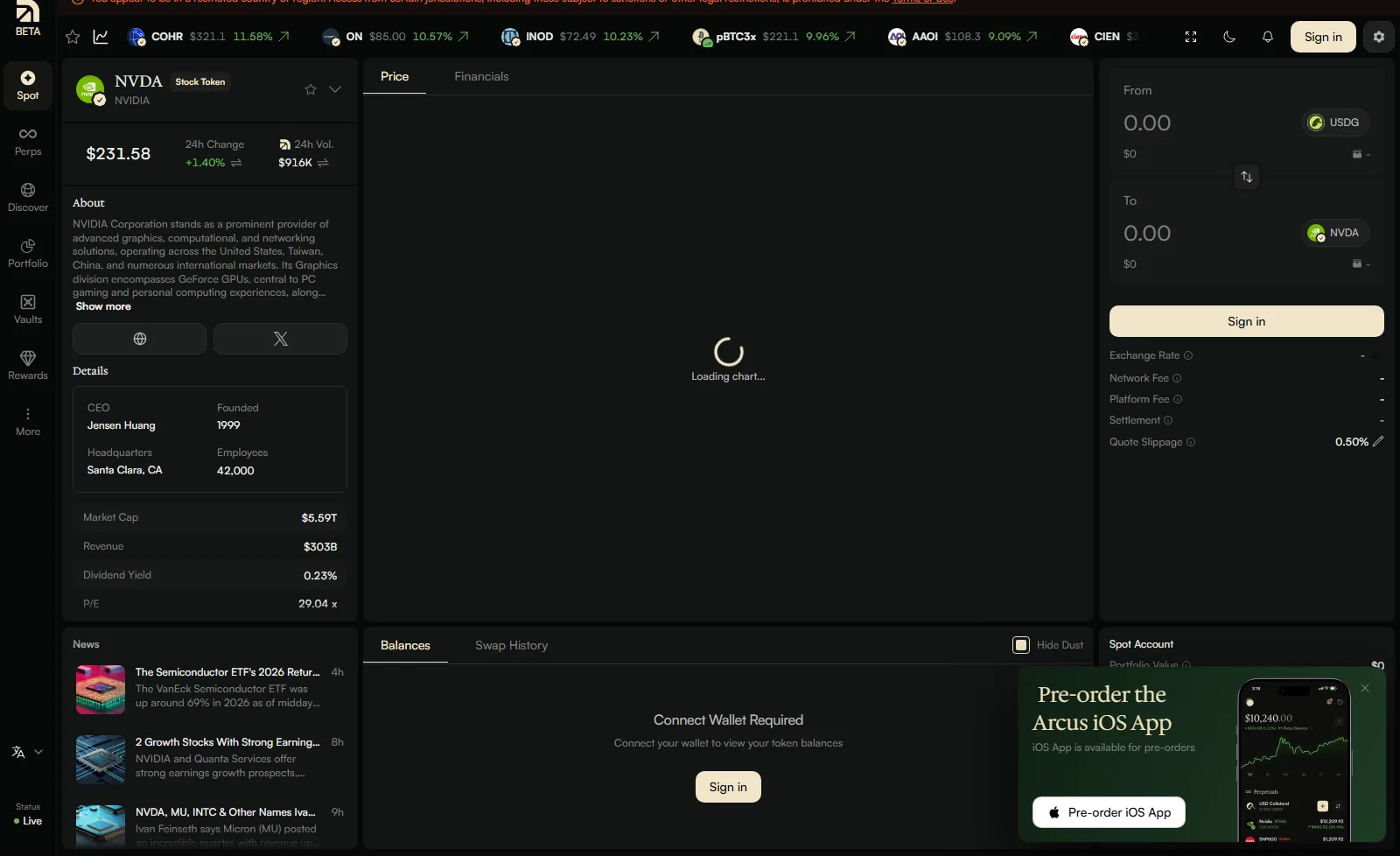
Arcus's spot router listed 242 tokens on Robinhood Chain on October 2, 2026, of which 179 were single stocks, 14 index or bond ETFs and 3 commodity ETFs (router token list). Arcus itself says it has "over 190" Stock Tokens. Orders run from a $10 minimum to $1,000,000 per order.
Which names trade on weekends
Arcus's September 18 post, Can I Trade Stock Tokens on Weekends?, splits coverage into two windows. "The most liquid Stock Tokens, large-cap tech and the major ETFs, quote 24/7, weekends included." Every other listed name "quotes 24/5, around the clock on weekdays, and rests over the weekend." Arcus says it intends to widen weekend coverage over time. It does not publish a fixed list of which names fall in which window, so the practical test is the app: if a name returns no quote on a Saturday, it is a 24/5 name.
What it costs at 3 a.m.
There is no order book for spot. You ask for a price, market makers compete through an RFQ, and the best firm quote wins. During US hours a maker can hedge your trade on the exchange in seconds, so spreads are tight. Once the market closes, whoever fills you holds the position until the reopen, and the spread widens to cover that risk. Arcus's off-hours spot post says a heavily traded name like NVDA stays "straightforward to price at any hour," while a thin name can briefly return no quote at all.
Three habits help, all from the Help Center's slippage page:
- Read the quote and price impact before you sign. Execution never settles worse than your slippage tolerance.
- Split large orders in thin names. Smaller sizes usually get better pricing.
- If a quote looks wide, check again during US hours. It usually tightens at the reopen.
Spot trades carry no Arcus fee, and most token-to-token swaps are gasless. The Help Center still advises keeping a small amount of ETH on Robinhood Chain for some actions.
Settled, unsettled and the wrapped-token fallback
After a buy, your balance can show part of the position as unsettled. That happens when the maker commits to your price before it has the tokens in inventory. Delivery is often instant and otherwise "typically completes within about 3 to 15 minutes," according to Arcus's settlement post. Your USDG waits in an escrow contract, and if delivery misses the deadline you reclaim it automatically. The one thing you cannot do is sell or transfer the unsettled quantity until it lands, so a fast in-and-out trade needs those minutes built in.
For long-tail names with no native fill, a whitelisted maker mints a wrapped token such as wTSLA that settles into the real token on the maker's cadence ("for example every 24 hours", per the wrapped tokens doc). The docs are candid that v1 relies on trusted makers and that "any unsettled position is a credit risk that must be covered."
Trade Arcus for 5% less
Join with code ARCUSGUIDE and Arcus takes 5% off your trading fees, automatically. It costs nothing, and the code attaches at signup, so add it on day one.
Get 5% Off Arcus FeesEquity, index and commodity perps
Perps are the other half. They reference a stock, ETF or commodity ETF price, carry leverage, and settle profit and loss in USDG. They never expire, which is why they can trade straight through a weekend. A snapshot of GET https://api.arcus.xyz/v1/markets at 04:34 UTC on 2026-10-02 showed 42 real-world-asset markets, 36 of them online:
| Category | Online markets (max leverage) | Largest OI caps |
|---|---|---|
| Indices | SPY 50x, QQQ 25x (VT and SGOV offline) | SPY $8M, QQQ $4M |
| Commodities (ETF-based) | GLD 25x, SLV 25x, USO 20x, CPER 10x | GLD $4M |
| Equities | NVDA and AAPL 20x; AMD, INTC, GOOGL, META, MU, BABA, HOOD, CRCL, TSLA, AMZN, MSFT, SNDK, DRAM, PLTR, CRWV, ORCL, BE, USAR, SKHY, MSTR, GME, QNT, MRNA 10x; SPCX, COIN, NBIS, MRVL, BOT 5x | NVDA and HOOD $4M, SNDK $2M |
Every RWA market carries its own open-interest cap (openInterestCapNotional). Caps run from $8M on SPY down to $100,000 on QNT and MRNA, so in a crowded name the cap can stop new positions before liquidity does. Two tickers trip people up: QNT is Quantinuum, not the Quant crypto token, and SPCX is listed as Space Exploration Technologies Corp. Commodity perps track ETFs (GLD, SLV, USO, CPER), not futures. Arcus says futures-based commodity perps are under consideration with no timeline.
Per-market pages such as NVDA and SPY carry the current numbers.
The off-hours regime, rule by rule
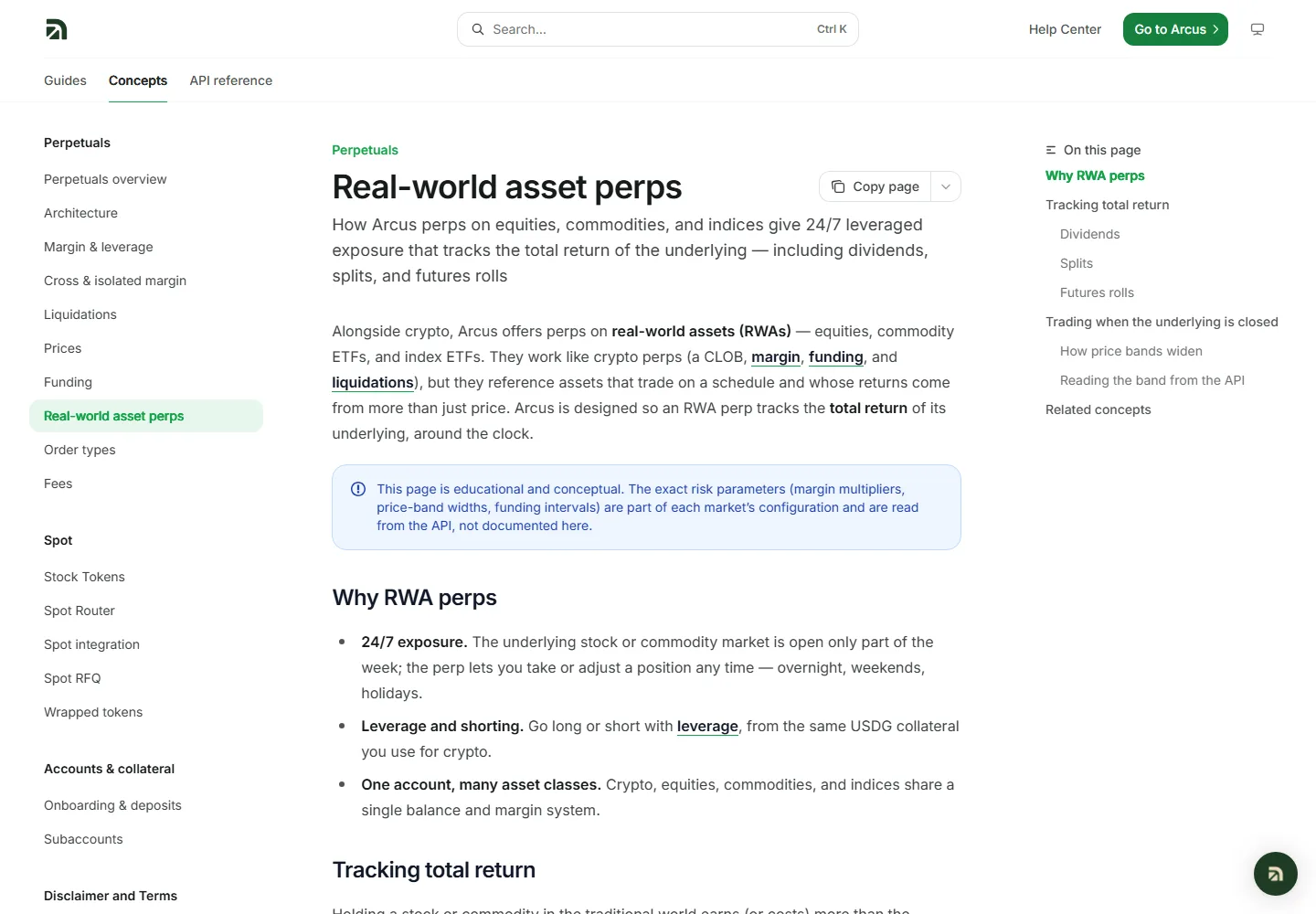
Here is the detail that is easy to miss: Arcus's perps do not use the NYSE's 9:30 to 16:00 session as their clock. Every RWA market in the API has regularTradingHours set to 04:00 to 20:00 America/New_York, which is pre-market through post-market. Inside that window the perp tracks the live  Pyth oracle. Outside it (weeknights from 20:00 to 04:00 plus the whole weekend, 88 hours a week) the market stays open and the real-world asset perps doc switches on four guardrails:
| Guardrail | In regular hours | Off-hours |
|---|---|---|
| Initial margin | Market's initialMarginFraction | offHoursInitialMarginFraction, currently 1.5x on every RWA market |
| Maintenance margin | Standard | Unchanged |
| Price | Tracks the oracle | Held inside bands around a sealed settlement price |
| Funding | Premium plus base rate, hourly | Fixed base rate of SOFR + 0.5%, still settled hourly |
| Mark price | Anchored to the oracle | 2.5-minute EWMA of the order book's impact mid, bounded by the bands |
Margin. The 50% uplift means a market you can open at 10x in session tops out near 6.7x off-hours, and a 5x market near 3.3x (margin doc). At the snapshot, TSLA-USD showed an initial margin fraction of 0.10 and an off-hours fraction of 0.15. Because maintenance margin does not move, the close does not push an existing position toward liquidation. What it does do is shrink your free collateral at 20:00 ET with no trade, transfer or price move involved.
Your buying power drops at 20:00 ET
Price bands. At each weekday 20:00 ET close the engine seals a settlement anchor, a VWAP of the closing session, and centers a band on it. The band edge sits at anchor × (1 ± initialMarginFraction × multiplier), and the multiplier climbs a one-way ladder: 0.5x, 1x, 2x, 4x. A side widens one rung only after the one-hour EWMA of its impact price has sat at or beyond 90% of the distance to the edge for a continuous hour. The two sides move independently, a widened side never narrows within the session, and there is no halt. Orders fill up to the boundary and the rest is rejected with FILL_WILL_EXCEED_TRADING_BOUND. On a 10x market the 4x ceiling allows a move of up to ±40% from the anchor; on a 5x market, ±80%.
Funding. Arcus's funding post explains that off-hours "the premium switches off" and the base rate becomes the whole rate. At the snapshot every RWA market showed a funding rate of 0.000509% per hour, about 4.5% a year, which is SOFR plus 0.5% at that moment. Longs pay that to shorts while the market is closed, so carrying a long over a weekend has a cost you can work out on Friday. Live rates are on the funding rates tool.
Weekend gap risk: a worked example
The bands slow a weekend move down, and that is all they do. Here is how a gap plays out, using the live TSLA-USD band from the snapshot and then simple round numbers.
What the snapshot showed. At 00:34 ET on Friday, October 2, TSLA-USD (a 10x market) had a settlement anchor of $355.49. Its first-rung band ran from $337.72 to $373.26, which is ±5%. The next lower bound waiting on the ladder was $319.95, or −10%.
The scenario. Take a 10x stock with a Friday 20:00 anchor of $100. You are long $10,000 of notional on $2,000 of margin (5x). Maintenance margin on Arcus's 10x markets is a fraction of 0.0667, so your liquidation price works out near $85.70, about 14% below the anchor. On Saturday morning bad news breaks, and the market expects the stock to open 12% lower on Monday.
| When | What happens to the perp |
|---|---|
| Fri 20:00 ET | Anchor seals at $100. Band ±5%: $95 to $105 |
| Sat, after the news | Sellers push the price to $95. Fills below $95 are rejected |
| One hour later | Lower side has held in its zone for an hour: band widens to $90 (1x rung) |
| Another hour later | Still pressed: lower band widens to $80 (2x rung). Price can now trade at the expected $88 |
| Mon 04:00 ET | Regular hours resume, the oracle returns, and the mark re-anchors to the live pre-market price |
Your position is not liquidated: $88 is above $85.70. But your equity has gone from $2,000 to about $800, a 60% loss on margin, from one headline on a day the NYSE never opened. Now change one input. Had you opened at 8x ($1,250 of margin), the liquidation price would sit near $93.75, and the position would close out somewhere around the first band expansion.
Two lessons follow. First, the bands buy time, at least an hour per rung, but a real repricing gets through in a few hours. Second, any gap the bands have not absorbed by Monday shows up at 04:00 ET, when the mark snaps back to the oracle. Leverage you would accept on a Tuesday afternoon is a different bet across 56 hours on one anchor. A Stock Token holder, by contrast, can see the same −12% in the quote but cannot be liquidated, and can sell if a maker is quoting.
Dividends and corporate actions: the docs and the Help Center disagree
For Stock Tokens, both sources agree: dividends are reinvested and show up as a balance adjustment, never as cash, and splits adjust balances the same way.
For perps, they do not agree, and you should know which one you are reading:
- The real-world asset perps doc says that when a stock goes ex-dividend, "Arcus offsets it with a funding payment to longs." Its example: a $100 stock pays $2 and opens at $98, and the long nets flat.
- The Help Center's corporate actions answer says: "In future, cash dividends will be credited to longs and debited from shorts on the ex-date (currently, it is incumbent on market makers to price the perps price and funding to reflect dividend payments)."
Which one to trust
On other actions the Help Center is consistent: splits scale position size and entry price, M&A and spin-offs trigger settlement or adjustment, and a delisting gives you a published window to close before open positions settle against a final reference price. Trading may pause on a market ahead of a delisting or completed merger, with the window announced on @Arcus_xyz.
Points boosts for off-hours and RWA trading
Arcus's points announcement of October 1 lists two boost categories live at launch of Season 1: "trading Stock Tokens and other RWAs currently earns more," and "trading outside regular US market hours also currently earns more." Arcus adds that "boost categories are subject to change." Its terms (Annex C of the Protocol Terms) say points carry no right to any token or airdrop and can be changed retroactively. Read the boost as a small tilt in a program with no promised payout, not as a reason to trade at 2 a.m. The full picture is in Arcus points, token and airdrop.
Who can trade this
Spot Stock Tokens are open to anyone in an eligible region, with no code or waitlist. Perps sit behind an access gate: you need an invite code from an existing trader (they earn one per $1M of qualifying volume) or a waitlist slot. A referral link alone does not unlock perps; invite codes and the waitlist explains the difference. Arcus restricts the United States, Canada, the United Kingdom and sanctioned regions, and its Help Center lists Switzerland as restricted for spot. If the app shows a regional banner, read Arcus not available in your country before anything else.
If you are new to the app, how to trade on Arcus covers wallets, the Enable Trading signature and your first order, and how to deposit covers getting USDG in. For how the equity perp books compare with other venues, see Arcus vs Hyperliquid and Arcus vs Lighter.
Trade the other 135 hours
Open Arcus with code ARCUSGUIDE and Arcus applies its 5% referral discount on trading fees. Spot Stock Tokens are open in eligible regions with no waitlist.
Open Arcus with ARCUSGUIDEArcusGuide earns a share of the trading fees paid by accounts that join with code ARCUSGUIDE, at no extra cost to you. Nothing here is financial, legal or tax advice. Leveraged perps can lose more of your margin than you expect over a single weekend.
Frequently Asked Questions
Yes, with limits. Arcus says its most liquid Stock Tokens, such as large-cap tech names and the major ETFs, quote 24/7 including weekends, while other names quote 24/5 and rest over the weekend. Equity, index and commodity perps trade all 168 hours of the week, under a stricter off-hours rule set when the underlying market is closed.
Arcus charges no trading fee on Stock Token spot trades at any hour. The cost is the market maker's spread built into your quote, and Arcus says that spread widens outside US market hours because makers cannot hedge until the stock market reopens.
Per Arcus's docs, four things change outside the 04:00 to 20:00 ET weekday window: initial margin rises 50 percent, trading is held inside price bands around the last session's settlement price, funding locks to a fixed SOFR plus 0.5 percent rate, and the mark price becomes a 2.5-minute moving average of the order book. Maintenance margin does not change.
Not as cash. Arcus's docs and Help Center say the value of a dividend is reinvested into the backing of the token and your displayed balance is adjusted by an on-chain oracle update. Stock Tokens carry no voting rights.
Spot Stock Tokens are open to users in eligible regions with no waitlist. Perps need an invite code or a waitlist slot. Arcus restricts the United States, Canada, the United Kingdom and sanctioned regions, and its Help Center also lists Switzerland as restricted for spot.
Independent resource: ArcusGuide is an independent, third-party resource operated by Concept211. It is not affiliated with, produced by, reviewed by or endorsed by Arcus Labs Ltd, Arcus Labs Inc., Pocket Protector Labs Inc., dYdX Trading Inc. (dYdX Labs), the dYdX Foundation, Robinhood or any of their affiliates. "Arcus" and related names and marks belong to their respective owners and are used here only to identify the platform this site documents. Read the full disclaimer.
Availability: Arcus perpetual contracts and derivatives trading features are not available to persons in the United States, Canada, the United Kingdom or other restricted or sanctioned jurisdictions, and Arcus restricts spot trading there too. This site is not intended for persons in those jurisdictions. Do not use a VPN or any other tool to get around a regional restriction; Arcus prohibits it.
Not advice: Nothing on this site is legal, tax, financial or investment advice. Descriptions of regulatory status, tax treatment and market availability are general information that varies by jurisdiction and changes over time. Confirm anything that matters to you with a qualified professional and against primary sources. Trading perpetual futures with leverage carries a substantial risk of loss, and past performance does not indicate future results.
Disclosure: this site contains referral links. Joining Arcus with code ARCUSGUIDE takes 5% off your trading fees and earns us a share of the fees Arcus already charges, at no extra cost to you.
Trade Arcus for 5% less
Join with code ARCUSGUIDE and Arcus takes 5% off your trading fees, automatically. It costs nothing, and the code attaches at signup, so add it on day one.
Get 5% Off Arcus Fees