What Are Stock Tokens? Robinhood Stock Tokens vs Arcus Stock Tokens Explained
Table of Contents
Search "stock tokens" and you get two different Robinhood products, a handful of rival issuers and several exchanges that list them, often described as if they were one thing. They are not. This guide explains what a stock token is, who issues the ones you can trade, and how Robinhood's in-app EU product differs from the on-chain Stock Tokens on  Arcus. Every number below was checked against the issuer's or the venue's own pages on October 2, 2026.
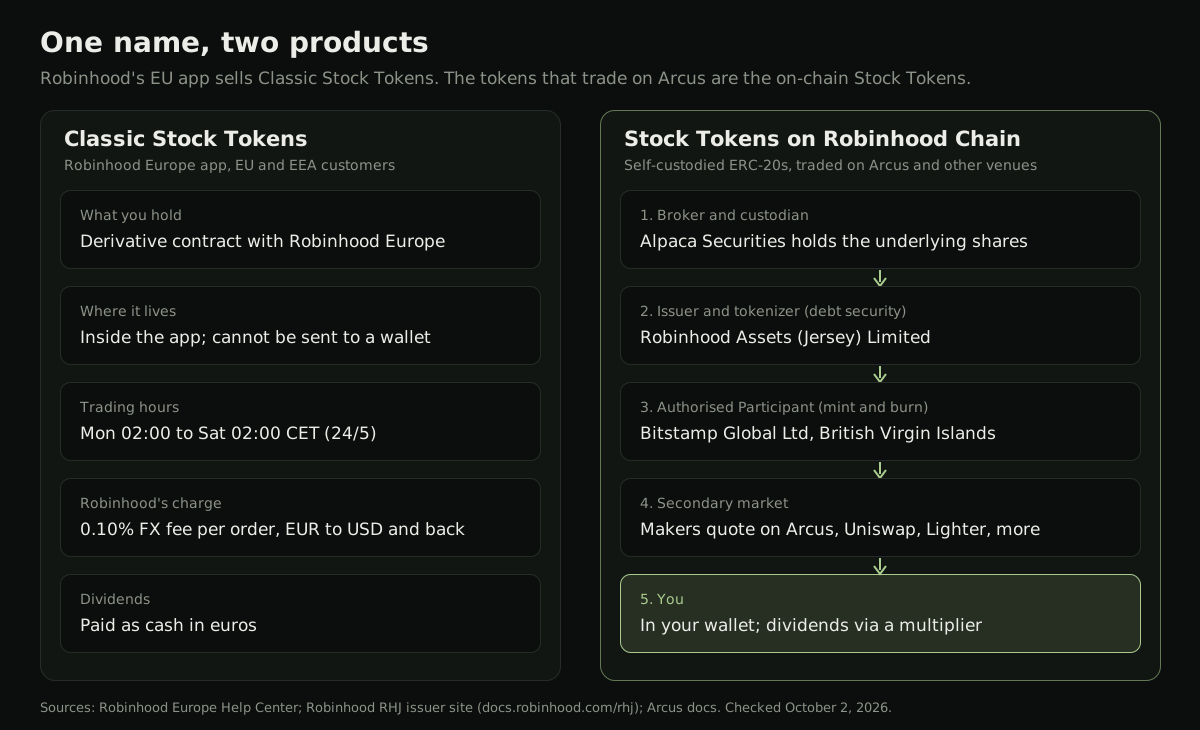
 Robinhood runs two products under the name. Classic Stock Tokens are derivative contracts inside the Robinhood Europe app. Stock Tokens on Robinhood Chain are debt securities issued by Robinhood Assets (Jersey) Limited that you hold in your own wallet, and those are the tokens Arcus lists for spot trading with no Arcus fee.
What a stock token is
A stock token is a token on a blockchain whose price follows a publicly traded stock or ETF. Buy an NVDA token and its value moves with Nvidia shares. What you own, legally, is a claim on whoever issued the token, not a share registered in your name.
That claim takes different forms. Robinhood's European help center describes its Classic Stock Tokens as "derivative contracts between you and Robinhood." The on-chain Stock Tokens are "tokenised debt securities issued by Robinhood Assets (Jersey) Limited," according to Robinhood's issuer site. Both give you economic exposure to the share price. Neither gives you voting rights.
Three questions separate one stock token from another:
- Who issued it, and what backs it? Real shares in custody, a broker's balance sheet, or nothing but an oracle price.
- Where can it go? Some tokens never leave the app that sold them. Others are standard tokens you can send to any wallet.
- How do you get your money out? Sell to another trader, sell back to the platform, or redeem with the issuer.
The rest of this guide answers those three questions for the two Robinhood products, because those are the ones most people mean when they search for the term.
How the on-chain Stock Tokens are issued and backed
The supply chain behind each on-chain Stock Token has more parties than most people expect. Robinhood's service provider page lists them:
| Role | Entity |
|---|---|
| Issuer and tokenizer | Robinhood Assets (Jersey) Limited ("RHJ"), Jersey |
| Authorised Participant | Bitstamp Global Ltd, British Virgin Islands |
| Broker and custodian of the shares | Alpaca Securities LLC, New York |
| Paying account provider | JPMorgan Chase Bank, N.A., London Branch |
| Security agent and verification agent | Security Agent Services AG, Zug |
RHJ creates the tokens. Only an Authorised Participant can subscribe for new tokens from RHJ, and Robinhood's Chain docs say there was a single one at issuance. The service provider page names it: Bitstamp Global Ltd. Robinhood's issuer FAQ says every token in circulation "is backed 1:1 by the corresponding underlying equity," with the shares held by a US custody partner. If RHJ became insolvent, the FAQ says an independent security agent would sell the shares and pay the cash to token holders.
This also clears up a naming question.  Arcus's docs and Help Center say its Stock Tokens are "issued by Bitstamp," minted by Bitstamp Global Ltd. (BVI). Robinhood's disclosures put Bitstamp in the Authorised Participant seat and name RHJ as the legal issuer. The tokens are the same: I compared the router list Arcus publishes for
  Robinhood Chain with Robinhood's asset registry, and 194 of the 196 stock and ETF tokens on Arcus's router have the same contract addresses as the 194 assets in Robinhood's registry. The other two, ZETA and QNT, were not in the registry response that day. If you want to know who you have a claim against, read RHJ's disclosures.
Check the contract address, not the ticker
Redemption: cash, never shares
A Stock Token cannot be swapped for the real share. Arcus's Help Center says so in plain terms: each token "carries a contractual right to redeem with the issuer for the cash market value of the linked security."
In practice, most holders exit by selling. Robinhood's Chain docs say direct mint and burn "is available only to Authorized Participants / market makers" and that "regular holders acquire and exit positions on the secondary market." The issuer FAQ adds a fallback: holders can redeem with RHJ directly "where there is no authorized participant," after passing RHJ's identity checks. RHJ's product page sets the investor fee at 0% for subscription, 0% for redemption in the first 90 days after issuance, and 0.05% for redemption after that. Those fees apply to the issuer route. Selling on a venue like Arcus has its own cost, covered below.
Robinhood Classic Stock Tokens vs Stock Tokens on Arcus
Robinhood launched stock tokens for EU customers in June 2025, issued at first on  Arbitrum. When Robinhood Chain's mainnet went live on July 1, 2026, Robinhood renamed that first generation: "The first generation of Stock Tokens, now called Classic Stock Tokens, will continue to be available in the Robinhood Europe app." The new on-chain Stock Tokens went to the Robinhood Wallet, which Robinhood says reaches "more than 120 countries," and to decentralized exchanges. The same post names "Uniswap, Rialto, Lighter, Arcus, and 1Inch."
So the useful comparison is Classic Stock Tokens against the on-chain Stock Tokens you trade on Arcus:
| Classic Stock Tokens (Robinhood Europe app) | Stock Tokens on Arcus (Robinhood Chain) | |
|---|---|---|
| Custody and transfers | Held in your Robinhood account; "you cannot send them to other wallets or platforms at this time" | ERC-20 in your own wallet; you can send it to any address except sanctioned ones |
| Trading hours | Monday 02:00 to Saturday 02:00 CET, with orders queued outside that window | Most liquid names quote 24/7 on Arcus; other names 24/5 |
| Platform fee | 0.10% FX fee per order, "no other fees from Robinhood" | 0% Arcus fee; cost is the market maker's spread, plus network fees in ETH |
| Legal form | Derivative contract with Robinhood Europe, UAB | Debt security issued by Robinhood Assets (Jersey) Limited |
| Issuer | Robinhood Europe, UAB (Lithuania) | RHJ (Jersey); Arcus's docs name Bitstamp Global Ltd as minter |
| Chain | "Recorded on a blockchain"; launched on Arbitrum in 2025 | Robinhood Chain (chain ID 4663) |
| Dividends | Paid as cash in euros | Reinvested; a multiplier raises the shares per token |
| Range | "2,000+" stocks and ETPs | 196 stock and ETF tokens on Arcus's router |
| Order size | From €1 | $10 to $1,000,000 per order |
| Currency | Euros in, priced in USD | USDG, a dollar stablecoin |
| Who can buy | Robinhood Europe customers in the EU and EEA | Eligible regions; not the US, UK, Canada or Switzerland |
Sources: Robinhood Europe's About Classic Stock Tokens, Classic Stock Tokens FAQ, corporate actions page and invest page; RHJ's issuer site; Arcus's docs and Help Center. All checked October 2, 2026.
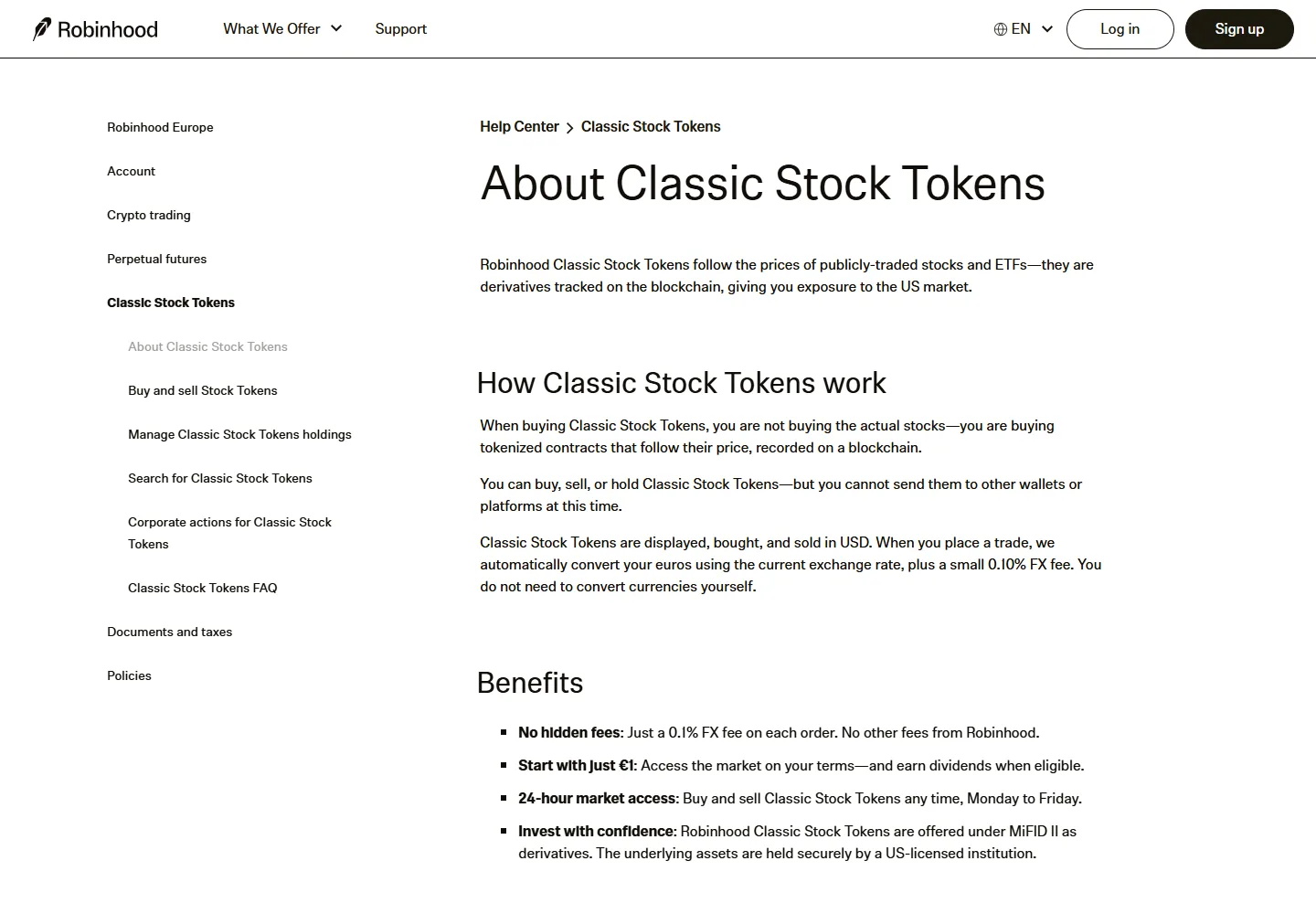
Source: Robinhood Europe Help Center, used under fair use for educational purposes
Each side wins somewhere. Classic Stock Tokens cover roughly ten times as many names and pay dividends as cash, so for someone in the EU who wants a plain brokerage experience in euros, they are the simpler product. The on-chain tokens are for people who want the token itself. You hold it, move it, and trade the most liquid names on a Sunday, and Robinhood's developer docs describe lending and collateral uses that a contract locked inside an app can't support.
Trade Arcus for 5% less
Join with code ARCUSGUIDE and Arcus takes 5% off your trading fees, automatically. It costs nothing, and the code attaches at signup, so add it on day one.
Get 5% Off Arcus FeesPricing outside market hours
The on-chain tokens trade at any hour, and the machinery behind them keeps a schedule. Robinhood's Chain docs say market makers can mint and burn tokens from Monday 02:00 to Saturday 02:00 CET/CEST, and "outside this window, minting and burning is not supported." End users "may still buy and sell Stock Tokens on-chain outside the tokenization window."
That explains the spread pattern Arcus describes. On Arcus there is no order book for spot. You request a quote, market makers compete through an RFQ, and the best firm price fills. Arcus's off-hours post says spreads widen when US markets close because a maker who fills you cannot hedge until the reopen. Arcus's weekend post splits coverage into two groups: large-cap tech and major ETFs quote 24/7, and other names quote 24/5 and rest over the weekend.
Robinhood also publishes a check on drift. Its price deviations page discloses any token whose on-chain price differs from the underlying's reference price by 5% or more for seven consecutive trading days.
The full off-hours picture, including which names quote on Saturdays and how to handle a wide quote, is in trading stocks 24/7 on Arcus. I won't repeat it here.
Dividends and corporate actions
The two products handle dividends in opposite ways.
Classic Stock Tokens pay cash. Robinhood Europe's corporate actions page says "you receive dividend payments in euros," with no FX fee on the payment and possible tax withholding depending on your region. Splits adjust your token quantity. Mergers, liquidations and delistings can end in a cash distribution, and trading in the affected token usually pauses from about 2 AM CET on the effective date until the US market day starts.
On-chain Stock Tokens pay no cash. Robinhood's issuer FAQ says the dividend "is automatically reinvested to purchase more shares of that stock," and the token's multiplier rises so that each token represents slightly more than one share over time. The Chain docs explain that the multiplier follows the ERC-8056 standard: your raw token balance stays fixed, and a uiMultiplier() value scales how many shares it stands for. The  Chainlink price feed for each token already includes the multiplier. Arcus's Help Center describes the effect from the user's side: "your displayed balance is adjusted accordingly," with no action needed. Splits use the same mechanism.
You can see it working. In Robinhood's asset registry on October 2, 2026, 45 of the 194 tokens had a multiplier above 1. SPY's stood at 1.0017, the accumulated effect of reinvested distributions, and CrowdStrike's at exactly 4.0, which is how this mechanism records a split.
Some things are not documented at all. Neither Robinhood's issuer site nor Arcus's docs explain how spin-offs or mergers are handled for on-chain tokens; RHJ has a corporate actions page for notices on specific events. Voting rights are not passed through on either product.
Stock tokens vs equity perps
Arcus offers a second way to trade the same stocks, and the two are easy to confuse. A Stock Token is spot: you own the token, there is no leverage, and nothing can liquidate you. An equity perp is a leveraged contract against USDG margin that never expires. You can go long or short with leverage that varies by market (NVDA and AAPL go to 20x, most single stocks to 10x), you pay or receive funding, and it can be liquidated. Perps on Arcus need an invite code or a waitlist slot; spot does not.
| Stock Token (spot) | Equity perp | |
|---|---|---|
| What you hold | A token in your wallet | A leveraged position |
| Short selling | No | Yes |
| Funding and liquidation | None | Yes |
| Arcus fee | 0% | 0.0225% taker, 0% maker at the base beta tier |
| Access | Eligible regions, no waitlist | Invite code or waitlist slot |
The perp fee is from Arcus's live fee tier endpoint on October 2, 2026; the full schedule is in Arcus fees explained. Live perp markets, open interest and leverage caps by name are on the equities market page, and the off-hours perp rules (higher margin, price bands, fixed funding) are in the 24/7 guide.
Risks worth knowing
None of this is advice. Stock tokens carry risks an ordinary brokerage account doesn't, and the issuers spell most of them out:
- You depend on the issuer. Classic Stock Tokens are a contract with Robinhood Europe, and its help center warns you can lose your capital through "the insolvency of Robinhood." On-chain tokens are a claim on RHJ, backed by shares at Alpaca, with a security agent lined up for an insolvency. RHJ's issuer page says the issuer "is not regulated," though it has obtained certain consents in Jersey.
- Liquidity can thin out. Arcus's disclaimer lists "limited redemption access, liquidity constraints, price or tracking divergences from the underlying." A thinly traded name can return no quote at all on a weekend night.
- Self-custody cuts both ways. Lose your keys and nobody can restore your on-chain tokens, which is why Arcus's disclaimer puts "private-key loss or compromise" first on its list.
- Delivery is not always instant. A fresh Arcus purchase can be locked for about 5 to 15 minutes, and long-tail names may arrive first as a wrapped placeholder from a market maker that settles later (Arcus docs).
- Where you live decides access. RHJ's restricted jurisdictions page bars US persons, restricts Canada, the UK and Switzerland, and lists prohibited investors in Cuba, Belarus, Iran, North Korea, Russia, Syria, Ukraine, South Sudan, Sudan, Myanmar and Venezuela. Robinhood's mainnet post also names the UAE. Arcus's Help Center says Arcus Spot is not available in the US, UK, Canada, Switzerland and other restricted jurisdictions. If that is you, Arcus is not for you; Arcus not available in your country explains what the terms cover.
Other issuers exist too. Arcus's Help Center names  Ondo, Backed and Swarm as tokenized-stock issuers and describes itself as a venue, not one of them. Their tokens have their own disclosures, and nothing above applies to them automatically.
Trade Arcus for 5% less
Join with code ARCUSGUIDE and Arcus takes 5% off your trading fees, automatically. It costs nothing, and the code attaches at signup, so add it on day one.
Get 5% Off Arcus FeesHow to buy Stock Tokens on Arcus
Arcus lets you buy Robinhood's on-chain Stock Tokens from your own wallet with a 0% Arcus fee and no waitlist in eligible regions. If you want to see the market first, the NVDA market page shows live data.
- Confirm you are in an eligible region. Spot is not available in the US, UK, Canada or Switzerland.
- Open Arcus and sign in with email or connect a wallet such as
 MetaMask. Joining through that link applies code ARCUSGUIDE, which has to go on before you build up volume.
 - Deposit. Arcus's deposit partner converts crypto from other chains, or card and bank payments, into USDG. The deposit guide walks through each route and its costs.
- On the spot page, set From to USDG and To to the Stock Token you want, enter an amount between $10 and $1,000,000, and read the quote before you sign. Execution never settles worse than your slippage tolerance.
- Keep a little ETH on Robinhood Chain. Arcus's Help Center says network fees on spot are paid in ETH, though Arcus's docs say most swaps are gasless.
Every screen, from first deposit to first trade, is in how to trade on Arcus, and what is Arcus covers the company and the perps side.
Hold the stock token in your own wallet
Open Arcus with code ARCUSGUIDE and Arcus applies its 5% referral discount on trading fees. Spot Stock Tokens carry no Arcus fee and need no waitlist in eligible regions.
Open Arcus with ARCUSGUIDEArcusGuide earns a share of the trading fees paid by accounts that join with code ARCUSGUIDE, at no extra cost to you. ArcusGuide is independent and not affiliated with Arcus, Robinhood or Bitstamp. Nothing here is financial, legal or tax advice.
Frequently Asked Questions
A stock token is a blockchain token that tracks the price of a stock or ETF. It is not the share itself. Depending on the product, it is either a derivative contract with a broker or a debt security from an issuer that holds the underlying shares, and it gives you the price exposure without shareholder rights such as voting.
The Stock Tokens on Arcus are Robinhood's on-chain Stock Tokens. Robinhood's issuer disclosures name Robinhood Assets (Jersey) Limited as the issuer and Bitstamp Global Ltd as the Authorised Participant, and the token contract addresses on Arcus match Robinhood's registry. Arcus is a trading venue, not the issuer. They are a different product from the Classic Stock Tokens sold inside the Robinhood Europe app, which are derivative contracts that cannot leave the app.
It depends on the product. Robinhood says Classic Stock Tokens in its EU app pay cash dividends in euros. The on-chain Stock Tokens traded on Arcus pay no cash: the dividend is reinvested and an on-chain multiplier raises the number of shares each token represents, so the value shows up in the token rather than as a payout.
No. Arcus's Help Center says a Stock Token cannot be redeemed for the underlying share; it carries a right to redeem with the issuer for the cash market value. Most holders exit by selling on a venue. Robinhood's issuer FAQ describes direct cash redemption with the issuer subject to identity checks, with a 0.05% fee after the first 90 days.
Users in eligible regions can trade Stock Tokens on Arcus spot with no waitlist or invite code. Arcus's Help Center says spot is not available in the United States, the United Kingdom, Canada, Switzerland and other restricted jurisdictions, and Robinhood's issuer site lists similar restrictions for the tokens themselves. This describes the published terms and is not legal advice.
Independent resource: ArcusGuide is an independent, third-party resource operated by Concept211. It is not affiliated with, produced by, reviewed by or endorsed by Arcus Labs Ltd, Arcus Labs Inc., Pocket Protector Labs Inc., dYdX Trading Inc. (dYdX Labs), the dYdX Foundation, Robinhood or any of their affiliates. "Arcus" and related names and marks belong to their respective owners and are used here only to identify the platform this site documents. Read the full disclaimer.
Availability: Arcus perpetual contracts and derivatives trading features are not available to persons in the United States, Canada, the United Kingdom or other restricted or sanctioned jurisdictions, and Arcus restricts spot trading there too. This site is not intended for persons in those jurisdictions. Do not use a VPN or any other tool to get around a regional restriction; Arcus prohibits it.
Not advice: Nothing on this site is legal, tax, financial or investment advice. Descriptions of regulatory status, tax treatment and market availability are general information that varies by jurisdiction and changes over time. Confirm anything that matters to you with a qualified professional and against primary sources. Trading perpetual futures with leverage carries a substantial risk of loss, and past performance does not indicate future results.
Disclosure: this site contains referral links. Joining Arcus with code ARCUSGUIDE takes 5% off your trading fees and earns us a share of the fees Arcus already charges, at no extra cost to you.
Trade Arcus for 5% less
Join with code ARCUSGUIDE and Arcus takes 5% off your trading fees, automatically. It costs nothing, and the code attaches at signup, so add it on day one.
Get 5% Off Arcus Fees